
I still remember the first time I stood in my first “adult” living room. I had the keys in my hand, a fast-beating heart, and absolutely no idea what to do next. The walls were a shade of beige that I can only describe as “sad oatmeal,” and the only furniture I owned was a beanbag chair from college and a lamp that leaned aggressively to the left.
We have all been there. We want our homes to tell our story—to reflect who we are, where we’ve been, and what we love. But bridging the gap between the vision in our heads and the reality of our bank accounts (and square footage) is often where the dream falls apart.
For years, customization was a luxury reserved for those who could hire professional interior designers or architects. But recently, the script has flipped. Artificial Intelligence isn’t just for writing emails or generating code; it has become the ultimate creative partner for homeowners.
If you are looking to inject some serious personality into your space, 2025 is the year to do it. Let’s explore how you can use AI tools to customize your interior and exterior design, turning a generic house into a home that feels unmistakably yours.
The “Try Before You Buy” Revolution
The biggest barrier to customizing a home is fear. What if that dark moody blue makes the room look like a cave? What if those mid-century modern chairs clash with my grandmother’s vintage rug?
This is where AI shines. It allows you to fail fast and fail free, digitally.
Interior Visualization
If you are staring at a room that feels “off” but you can’t put your finger on why, tools like RoomGPT or Interior AI are fantastic starting points. You simply snap a photo of your current room, upload it, and tell the AI to reimagine it in a different style—be it “Cyberpunk,” “Japandi” (a 2025 favorite mixing Japanese rusticity with Scandinavian functionality), or “Maximalist.”
I recently used this for my home office. It was a cluttered mess of cables and mismatched bookshelves. I uploaded a photo and asked the AI for a “Biophilic Design” (a massive trend right now that focuses on bringing nature indoors). Within seconds, it showed me my exact room, but with hanging planters, natural wood textures, and a calming sage green palette. It didn’t do the work for me, but it gave me the confidence to buy that first gallon of green paint.
Pro Tip: Don’t just stick to one style. Use these tools to mash up aesthetics. Ask for “Industrial Farmhouse” or “Bohemian Brutalist.” The results might be wild, but they will spark ideas you never would have found on a Pinterest board.
The Art of the Walls: Your Personal Gallery
Nothing screams “custom” quite like the art on your walls. We have all walked into homes that rely on generic store-bought art—you know, the black-and-white photos of a rainy London phone booth or a generic botanical print that matches the sofa too perfectly. It fills the space, sure, but it lacks soul.
Customization is about storytelling. And this is where generative AI tools like Midjourney or DALL-E 3 have completely changed the game.
Imagine you have a cherished memory that you don’t have a photo of. Maybe it was a specific sunset during a honeymoon in Greece, or the way the light hit the trees in your childhood backyard. You can now describe that memory to an AI tool and have it generate a piece of art that captures the feeling of that moment.
From Digital Dreams to Physical Reality
Here is where the real magic happens. Once you have generated an image that speaks to you, you don’t have to leave it on your computer screen. You can transform these digital creations into high-quality custom print posters that serve as the anchor for your room’s design.
I did this recently for a friend’s nursery. She wanted a “Space Cowboy” theme but couldn’t find anything that wasn’t cheesy. We went into Midjourney and prompted: “A watercolor illustration of a brave cat wearing a vintage astronaut helmet, riding a rocking horse through the Milky Way, soft pastel colors, dreamy atmosphere.”
The result was adorable, unique, and deeply personal to her inside jokes. We used an AI upscaling tool (like Topaz Gigapixel or Upscale.media) to ensure the resolution was crisp enough for print, and then sent it off to a printing service.
Using custom print posters in this way allows you to swap out your art seasonally or whenever your mood changes, without the guilt of spending a fortune on original oils. It’s a low-risk, high-reward way to keep your home feeling fresh and curated.
Curb Appeal: Customizing the Exterior
We spend so much time worrying about the throw pillows that we often forget the “handshake” of our home: the exterior. Customizing the outside of your house used to be a terrifying gamble. Painting brick or changing siding is expensive and semi-permanent.
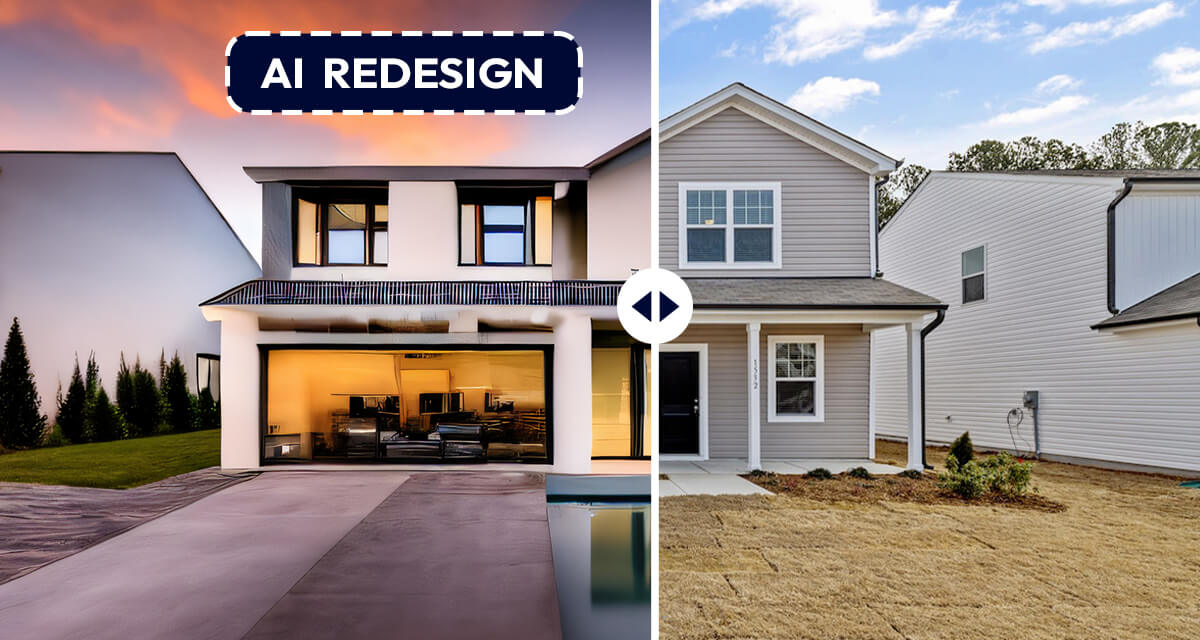
Enter AI exterior design tools like Remodel AI or HomeDesignsAI.
These apps allow you to take a photo of your house from the curb and digitally experiment with materials and colors. This is particularly useful for capitalizing on current trends. For 2025/2026, we are seeing a massive shift away from the stark “white farmhouse” look toward darker, moodier tones—think deep charcoals, forest greens, and rich plums (like Benjamin Moore’s Cinnamon Slate).
A Real-World Example
My neighbor was convinced she wanted to paint her brick house white. It’s a classic choice, but her house had beautiful mid-century lines that were begging for something bolder. I convinced her to let me run her house through an AI visualizer.
We tried the white, and it looked… fine. Clean. Safe.
Then, we tried a deep, slate blue with natural cedar accents on the pillars.
The difference was visceral. The AI render showed how the darker color made the landscaping pop and gave the house a sophisticated, architectural weight. She ended up going with the blue, and every time I drive by, I think about how a 30-second AI render saved her from a “safe” choice she would have eventually found boring.
Landscaping Matters Too:
Don’t stop at the structure. You can use these same tools to visualize landscaping. Ask the AI to add “drought-tolerant xeriscaping” or “an English cottage garden.” Seeing mature plants in your digital front yard helps you plan for the future, rather than just planting saplings and hoping for the best.
The Human Element: Using AI as a Compass, Not a Map
While these tools are incredible, there is a trap we need to avoid: The “Perfect Render” Syndrome.
AI generates idealized images. In an AI render, the light is always hitting perfectly, there are no dog toys on the floor, and the cables behind the TV don’t exist.
Customization requires a human touch to translate these perfect images into a livable reality. Here is how to keep it grounded:
- Texture is King: AI struggles to convey the feel of a room. If the AI suggests a velvet sofa, go to a showroom and sit on one. If it suggests a concrete wall, touch a sample. A customized home must feel as good as it looks.
- The “Weird” Factor: AI is trained on existing data, which means it tends to average things out. It pushes toward what is popular. To truly customize your home, you need to deliberately inject the “weird.” Put that ugly, sentimental vase on the mantle. Keep the mismatched chair you found at a flea market. Those imperfections are what make a house a home.
- Sustainability: Use AI to plan for efficiency. When visualizing your exterior, ask yourself: Can I add solar panels? Can I replace this lawn with clover to save water? The ultimate customization is a home that respects the environment it sits in.
Where to Start?
If you are feeling overwhelmed, start small. You don’t need to remodel your kitchen today.
- Pick one corner: Maybe it’s that awkward entryway or the blank wall above your bed.
- Snap a photo: Upload it to a free AI visualizer.
- Dream a little: Prompt for something wild. Ask for “70s conversation pit vibes” or “Futuristic Parisian apartment.”
- Create a artifact: Generate a piece of art based on a favorite song lyric and turn it into custom print posters. Hang it up. See how it changes the room.
Designing your home is a journey, not a destination. It is a constant process of tweaking, shifting, and refining as you grow and change. AI tools are simply the compass that helps you navigate that journey, ensuring that when you finally put down the paintbrush or hang that last picture frame, the home you are standing in feels exactly like you.
So, go ahead. Open that app, upload that photo, and start customizing. Your dream home is closer than you think.